What is a speech and language assessment?
It's our first proper session. Your child plays, I watch and listen, and afterwards I talk you through what I found.1 There's no pass or fail, and a child can't get it wrong.
The first step is usually the free 15-minute call, where we decide together whether an assessment makes sense. If it does, you book through the link and pay at the same time. You don't need a GP referral.2
What should I bring?
Yourself, and your child. Beyond that, a few things help:
- a favourite toy or comfort object, if your child has one
- any reports from nursery, school, the NHS or a health visitor
- a snack or drink, if your child will want one
- a short video of your child talking or playing at home, if you have one
- a list of the things you've noticed, or questions you want to ask
If you've written nothing down, it doesn't matter. We'll talk.
What actually happens in the room?
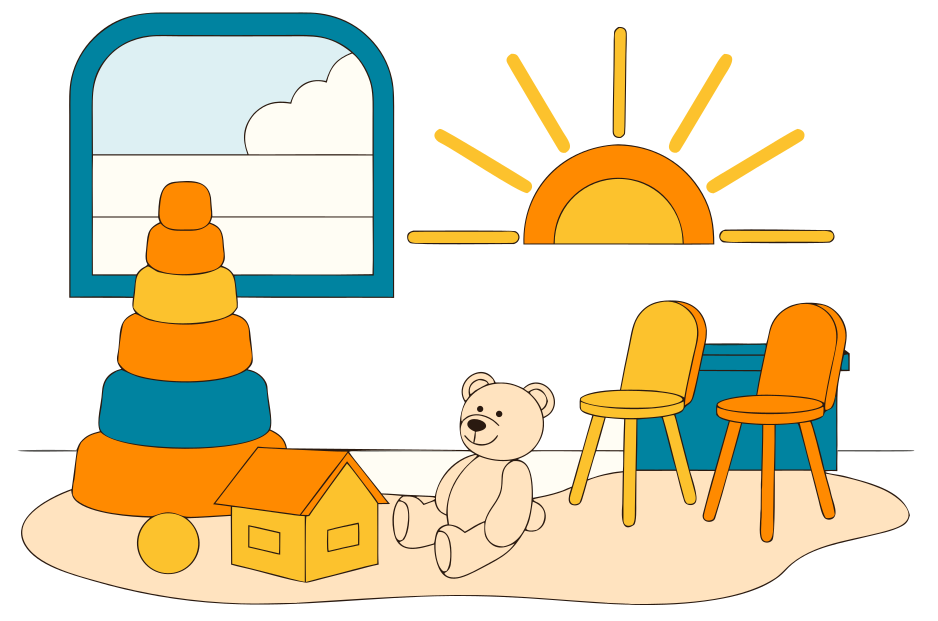
No clipboards and no drills. Mostly it looks like playing, because for a small child that is what learning looks like. There might be a dinosaur hiding under a blanket, a tea party, bubbles, or a pile of cars. I'll let your child lead for a while, and I'll copy what they do before I ask for anything.
While we play, I'm paying attention to a lot of small things: how your child lets me know what they want, what they understand, how they take turns, which sounds they use and how clearly, and how they use words and sentences. I also notice what they love, how they like to be spoken to, and what makes them uncomfortable. Some children are chatty from the start. Some stay near you for a long time first. Both are fine.
Some assessments use specific tools, such as the Renfrew Action Picture Test, the South Tyneside Assessment of Phonology or CELF-5, depending on your child's age and what I need to find out. When I use one, it's built into the play as far as possible, and I'd only use one if it suits your child on the day. If a child isn't up for it, I won't push them. I'm not looking for eye contact, and I'm not asking anyone to sit still. If your child needs to move around, hum, line things up or flap their hands, that's all welcome, and I'd rather learn from it.
You're in the room throughout. Many children are more at ease with a parent nearby, and I get to see how you and your child already communicate. You know them best.
If your child doesn't say a word in the room, I still learn plenty from the silence.
How long does it take, and who comes?
The length is agreed when you book, so you'll know before the day. Usually it's a parent or carer with the child. If both of you want to come, or a grandparent who spends lots of time with your child, that's fine too; just tell me beforehand so I can plan the room. If your child finds new places hard, say so on the call. We can take it slowly, and I'd rather change the room than ask your child to cope with it.
What happens after the play?
Once the session is over, I go through everything I noticed: the analysis. Then we have a proper conversation, where I tell you what I found, what I think is going on, and what I would do next.1 That might be therapy, advice for home, a word with the nursery, or sometimes no therapy at all. You leave knowing what I think.
I always start with what a child can already do, what they like and how they prefer to communicate, never with a list of what's missing. And I'll tell you if I think what's getting in the way is partly the environment, such as noise, how adults speak, or a lack of time to answer. Often the environment needs to change too.
Assessment isn't a diagnosis of autism. If you'd like to explore that, I'll talk it through with you, but diagnosis comes from a multidisciplinary team.34
What does it cost, and what's in the price?
The assessment is £270. That covers the session itself, the analysis afterwards, and the conversation with you about what I found and what I would do next. It does not include a written report.
A written report is £95 on top. It sets out in plain English what I found, what it means and what I recommend. I've kept it separate because not every family needs one. If a nursery, school or EHC needs assessment wants something on paper, you'll need the report. If you only want to understand your child better, you may not. The fees page has the full list, and the parents page covers the rest of how it works.
I'm a recognised Bupa provider. Email me and I'll check whether your policy covers sessions before you commit.
Do I have to carry on with therapy afterwards?
No. If we agree that therapy would help, sessions are £85 an hour, or you can book a block of eight for £680. There's no obligation, and no pressure to keep going.
Seeing me doesn't take your child off an NHS waiting list, and plenty of families do both. I'm glad to work alongside an NHS therapist.
If you're still working out whether a child's talking is worth an assessment at all, the late talkers guide might help. Or if you're comparing therapists, see how to choose a private speech therapist.
References
Sources checked on 18 October 2026.
- Royal College of Speech and Language Therapists. (n.d.). DLD: questions on diagnosis and support. https://www.rcslt.org/speech-and-language-therapy/clinical-information/developmental-language-disorder/dld-diagnosis-and-support/ ↩ ↩
- Royal College of Speech and Language Therapists. (n.d.). How to find a speech and language therapist. https://www.rcslt.org/speech-and-language-therapy/how-to-find-a-speech-and-language-therapist/ ↩
- NHS. (n.d.). Autism assessments. https://www.nhs.uk/conditions/autism/assessments/ ↩
- National Institute for Health and Care Excellence. (2011, updated 2017). Autism spectrum disorder in under 19s: recognition, referral and diagnosis (CG128). https://www.nice.org.uk/guidance/cg128 ↩