Autism and social communication
Speech therapy for autistic children and social communication
I am a neurodiversity-affirming speech therapist working with autistic children and children who find social communication hard. My aim is to help communication work for your child, not to make them look less autistic.
What does neurodiversity-affirming mean in a session?
It is a phrase people use a lot, so here is what it commits me to. I say "an autistic child", because most autistic people prefer it.1,2 If you prefer something else, tell me and I will use it.
I do not set targets for eye contact or sitting still. I do not train compliance, and I do not hand out rewards for doing as told. Stimming is welcome in my room. Every way of communicating counts, including gesture, scripts, objects, pictures and silence.
Communication goes both ways, which is the idea behind the double empathy problem: autistic and non-autistic people often misread each other, and neither side is simply wrong.3,4 So the work is rarely only about the child. The room, the noise, the pace and the way adults talk may need to change too.
I have particular experience in autism and social communication differences, and I have done the two-day ADOS-2 clinical workshop. I do not diagnose autism on my own. Diagnosis comes from a multidisciplinary team, which NICE says should include a paediatrician or child psychiatrist, a speech and language therapist and a psychologist.5 I can talk you through how to get on that route. You do not need a diagnosis to see me.
What might you be noticing?
- Your child finds back-and-forth conversation tiring, or would rather talk about one subject than chat.
- They repeat phrases from films, songs or books, and the phrases seem to carry meaning for them.
- They have few words, or none, and make their needs known in other ways.
- They find play with other children hard to join, or prefer to play alone.
- Changes of plan, noisy places or crowded rooms leave them overwhelmed.
- School describes them as quiet, or as having trouble with friendships or following the class.
How do you work with autistic children?
I start with what they love
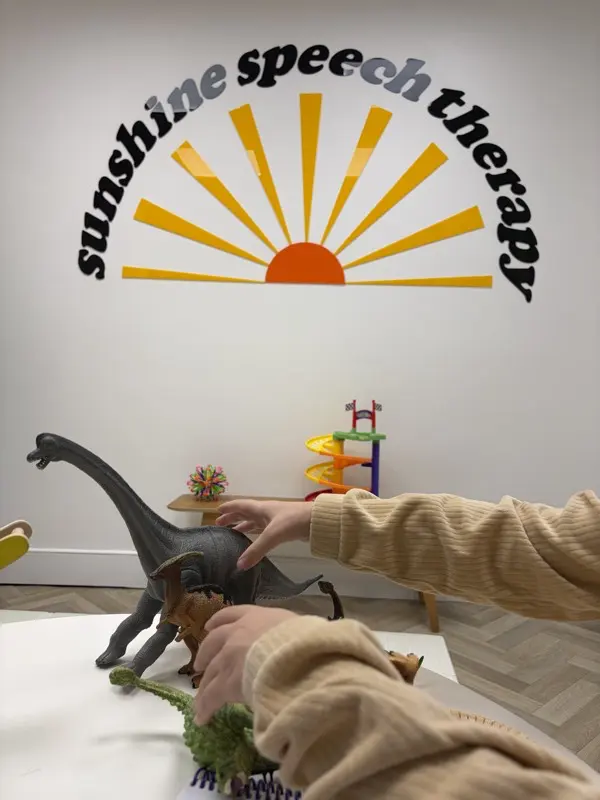
Dinosaurs, trains, a particular film. Special interests are the quickest way into a conversation, so that is where I begin.
I look at the whole situation
Sensory needs, how your child feels that day, how adults talk to them. I draw on SCERTS assessment, Intensive Interaction and Attention Autism, among other approaches, and I choose by child.
We agree on goals that matter to your family
That might be telling you when something hurts, joining a game with a sibling, or having a way to say no. We set goals with you, and with your child where we can.6
Many autistic children learn language in whole chunks. That is covered on the gestalt language processing page, and it applies to non-autistic children too. If speech is not reliable or not there yet, an AAC system can sit alongside it, and does not replace talking.
I can also work with your child's nursery or school, so the adults there understand how your child communicates. NICE recommends considering social-communication support built on play, with parents, carers and teachers taking part.7 Details are on the schools page, and you can read more about my approach on the about page.
An autistic child is often talking to people who haven't yet learned their language.
What does it cost?
Start with a free 15-minute call. An assessment is £270, and a written report, if you need one for a diagnostic team or school, is £95 on top. Therapy is £85 an hour. See the fees page or get in touch with questions.
- Free15-minute call
- £270Assessment
- £85Therapy, per hour
More on the fees page.
Questions parents ask
Do you diagnose autism?
Not on my own, no. A diagnosis comes from a multidisciplinary team.5 I can write up what I observe about your child's communication, which diagnostic teams and schools often find useful, and I can explain how referrals work.
My child is not diagnosed. Can you still help?
Yes. You do not need a diagnosis or a GP referral. If a child finds social communication hard, that is reason enough.
Will you try to stop my child stimming or scripting?
No. Stimming is allowed, and scripts are language. I only look closely at either if something causes your child pain or distress.
Can you work with my child's school?
Yes, I visit nurseries and schools across Redbridge, Waltham Forest, Newham, Tower Hamlets and Essex. I can also join annual reviews online.
References
Sources checked on 18 October 2026.
- Kenny L, Hattersley C, Molins B, et al. (2016). Which terms should be used to describe autism? Perspectives from the UK autism community. Autism, 20(4), 442–462. https://doi.org/10.1177/1362361315588200 ↩
- National Autistic Society. (n.d.). Guidance for the media. https://www.autism.org.uk/contact-us/media-enquiries/guidance-for-the-media ↩
- Milton DEM. (2012). On the ontological status of autism: the ‘double empathy problem’. Disability & Society, 27(6), 883–887. https://doi.org/10.1080/09687599.2012.710008 ↩
- Crompton CJ, Ropar D, Evans-Williams CVM, et al. (2020). Autistic peer-to-peer information transfer is highly effective. Autism, 24(7), 1704–1712. https://doi.org/10.1177/1362361320919286 ↩
- National Institute for Health and Care Excellence. (2011, updated 2017). Autism spectrum disorder in under 19s: recognition, referral and diagnosis (CG128), recommendations 1.1.3–1.1.4. https://www.nice.org.uk/guidance/cg128 ↩ ↩
- Royal College of Speech and Language Therapists. (n.d.). Autism: clinical information. https://www.rcslt.org/speech-and-language-therapy/clinical-information/autism/ ↩
- National Institute for Health and Care Excellence. (2013, updated 2021). Autism spectrum disorder in under 19s: support and management (CG170), recommendation 1.3.1. https://www.nice.org.uk/guidance/cg170 ↩
Other things I help with
Gestalt language processing
For children who learn language in whole chunks: film lines, songs, scripts.
Read more about Gestalt language processing
AAC
Signing, symbols, books or apps for children who don't rely on speech, or not yet.
Read more about AAC
Selective mutism
For children who talk at home and freeze at school or elsewhere.
Read more about Selective mutism
Want to talk it through first?
The free call is a chance to say what is worrying you and ask how I work. No pressure after it.