Selective mutism
Selective mutism
Does your child chat at home and go completely silent at school? As a selective mutism speech therapist in Wanstead, I help children and the adults around them take small, pressure-free steps towards talking where it feels hard.
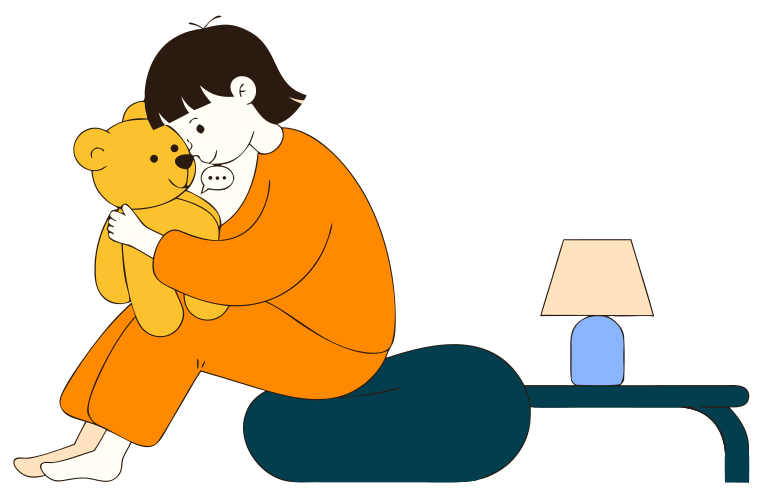
Why won't my child speak at school?
Selective mutism is an anxiety response, and the DSM-5 classes it as an anxiety disorder.1,2,3 A child who is perfectly able to talk freezes in certain places or with certain people, and the words simply do not come. It is not defiance, and they are not choosing silence to be difficult. Many children find it distressing themselves.
That is why it helps to stop asking them to speak. Pressure makes it worse, and the RCSLT advises parents not to pressure or bribe a child to speak.1 Questions, bribes, praise for talking and "go on, say hello" all raise the stakes, even when they are kindly meant.
Is it just shyness?
Shy children usually warm up with time. A child with selective mutism may stay silent for months in the same classroom, while chatting freely with the same family at the school gate. If that sounds like your child, the longer the silence goes on, the more fixed it can become, so asking early is sensible.1,2 I can usually tell you quickly, on the free call, whether it sounds like selective mutism or something else.
Some autistic children and children with language difficulties are also silent in some places. I look at that during assessment, because it changes the approach.
What might you be noticing?
- Your child talks easily at home and not at all at nursery, school or clubs.
- They freeze, look away or go still when someone speaks to them outside the family.
- They whisper to one friend but not to the teacher.
- They nod, point or wait for a sibling to answer for them.
- They have been silent in some settings for more than a month or two.
- They come home exhausted, or bursting with words after a day of holding them in.
What can school do, and what will you do?
Take the pressure off
First I help the adults stop waiting for speech. We make it fine to communicate any way at all: pointing, nodding, drawing, writing, gestures.
Build comfort in tiny steps
Then we work up a gradual ladder, based on what your child can already do. It might start with being in a room together, then sounds, then single words, then sentences. Your child sets the pace, and we go back a step whenever they need to.
Bring the new people in slowly
Over time, we widen the circle: a trusted friend, a teacher, then the wider class. I can visit school and plan this with staff, and I train staff if that would help.
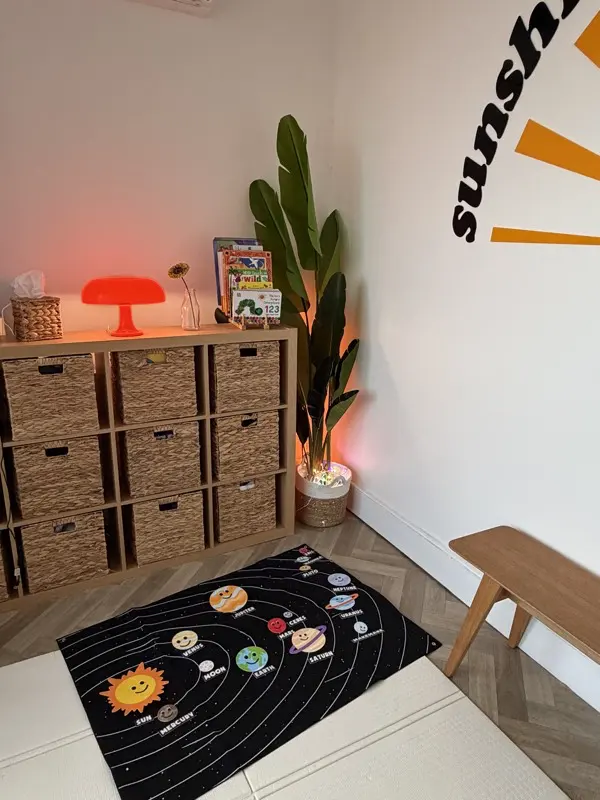
I work at my Wanstead clinic or at your child's nursery or school, and often both. The schools page explains how visits work. Sessions with your child are play, and nobody will ask them to talk.
Anxiety can show up differently across children. I ask you and your child what feels hard before I suggest anything.
I am not trying to make a child speak. I want the room to feel safe enough that speech can come when they are ready.
What does it cost?
A free 15-minute call comes first. Assessment is £270 and a written report, useful to share with school, is £95 extra. Therapy is £85 an hour, and a school visit is £85 an hour. All on the fees page; questions go through the contact page.
- Free15-minute call
- £270Assessment
- £85Therapy, per hour
More on the fees page.
Questions parents ask
Should I push my child to talk?
No. Encouragement is fine, but pushing, bribing and praising speech tends to increase anxiety. Let them communicate in other ways while we work on the underlying worry.
Can you work with school?
Yes. I visit schools across Redbridge, Waltham Forest, Newham, Tower Hamlets and Essex. A shared plan between home and school is usually where the progress is.
My child talks to me but not to their grandparents. Is that selective mutism?
It might be, if it is lasting and not just a settling-in period. It is worth a call, and I can say more after hearing about your child.
Will my child grow out of it?
Some children do, but I can't predict which. Early support is linked to better outcomes in a shorter time, so it is worth asking sooner.1
References
Sources checked on 18 October 2026.
- Royal College of Speech and Language Therapists. (n.d.). Selective mutism: clinical information. https://www.rcslt.org/speech-and-language-therapy/clinical-information/selective-mutism/ ↩ ↩ ↩ ↩
- NHS. (n.d.). Selective mutism. https://www.nhs.uk/mental-health/conditions/selective-mutism/ ↩ ↩
- Muris P, Ollendick TH. (2015). Children who are anxious in silence: a review on selective mutism, the new anxiety disorder in DSM-5. Clinical Child and Family Psychology Review, 18(2), 151–169. https://doi.org/10.1007/s10567-015-0181-y ↩
Other things I help with
Autism and social communication
Neurodiversity-affirming support for autistic children and social communication needs.
Read more about Autism and social communication
Language and communication
Children who are slow to talk, put few words together or find instructions hard.
Read more about Language and communication
Speech sounds and apraxia
For children who are hard to understand, including childhood apraxia of speech.
Read more about Speech sounds and apraxia
Is your child silent at school?
Tell me what you are seeing on a free call. I will listen first.