Feeding
Feeding therapy for children
Paediatric feeding therapy for children who gag, avoid textures or eat only a handful of foods, at my clinic in Wanstead.

Fussy eater, or something more?
Lots of children go through a picky phase, and it passes. Some don't. If mealtimes have become a daily battle, or your child's list of safe foods keeps getting shorter, it's worth asking for help rather than waiting it out. Sometimes it is more than fussiness. With avoidant restrictive food intake disorder (ARFID), a person avoids certain foods or eats very little because of things like texture, smell, a bad experience with food or low appetite, not because of worries about weight, and a GP can arrange an assessment.1,2
Speech and language therapists work with feeding because eating and talking use the same mouth, the same muscles and a lot of the same sensory information, and the RCSLT describes feeding as a central part of the speech and language therapist's role.3 I look at how your child tolerates different textures, smells and temperatures, how they move food around their mouth, and what mealtimes feel like for everyone at the table.4
I attended the SOS Approach to Feeding conference (Dr Kay Toomey and associates, 2023), and it shapes how I think about food: as something a child gets comfortable with in small steps, not something to be pushed. I should be honest that there is very little published research on how well the SOS Approach works, so I use it as a way of thinking about feeding, not as a proven treatment.5 I'm not SOS certified and I won't say I am.
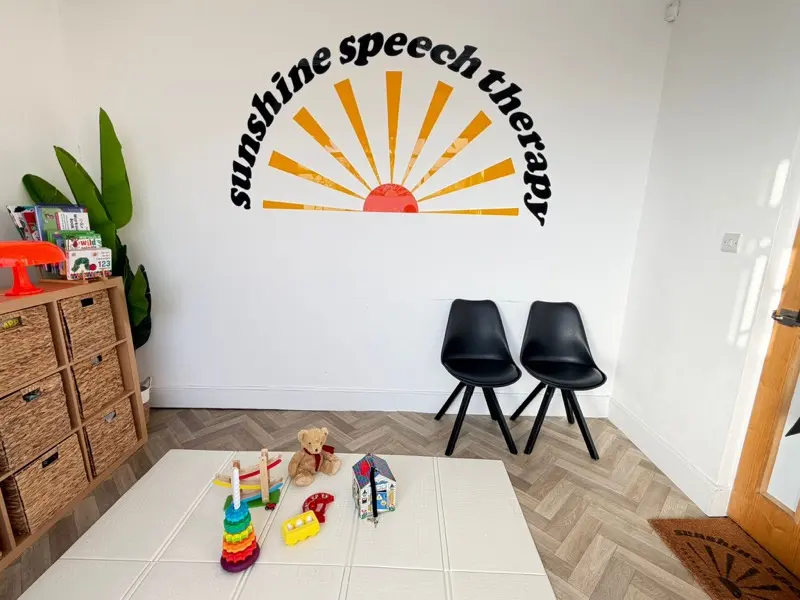
What might you be noticing?
- Your child gags on certain textures, or at the sight or smell of some foods.
- They eat a very small range of foods, and it's getting smaller.
- Mealtimes are stressful and often end in tears, theirs or yours.
- They hold food in their mouth, or chew for a very long time.
- They avoid new foods completely, even touching them.
- You're cooking separate meals every day and worry about what they're getting.
How does feeding therapy work?
A conversation first
We talk through what mealtimes are like, what your child eats now, what they've refused and what has happened in the past. You know your child best, so I listen before I do anything else.
Watching and trying, gently
I observe how your child manages different foods and textures, and how their mouth moves. If the way they use their lips, tongue or jaw looks like part of the picture, I'll talk to you about oral motor skills too.
Small steps, no pressure
Sessions are play-based. Your child might touch, smell or just sit near a new food. We go at their pace, and you leave with things to try at home that don't turn the table into a stand-off.
Nobody should be made to eat a food they're frightened of, so we build up to it one comfortable step at a time.
Questions parents ask
What is the SOS approach to feeding?
It's an approach that looks at the whole range of things involved in eating, from tolerating food on the table to touching, smelling, tasting and swallowing it. It moves in small steps and doesn't force a child to eat. I attended the SOS conference in 2023 and use its thinking in my sessions. The published research on how well it works is limited.5
Do I need a medical check first?
If there are worries about swallowing, choking, weight or growth, yes, please see your GP first.6 For other feeding concerns you don't need a referral to see me. Either way, I won't diagnose anything medical.
Will you make my child eat?
No. Pressure usually makes things worse. The aim is for your child to feel safer around food, which can widen what they're willing to try over time. I can't promise what they will eat.
Can you come to nursery or school?
Yes, I visit nurseries and schools across Redbridge, Waltham Forest, Newham, Tower Hamlets and Essex. Lunchtime is often where staff notice difficulties first. See the schools page.
References
Sources checked on 18 October 2026.
- NHS. (n.d.). Eating disorders: overview (includes ARFID). https://www.nhs.uk/mental-health/feelings-symptoms-behaviours/behaviours/eating-disorders/overview/ ↩
- Beat Eating Disorders. (n.d.). ARFID: avoidant/restrictive food intake disorder. https://www.beateatingdisorders.org.uk/get-information-and-support/about-eating-disorders/types/arfid/ ↩
- Royal College of Speech and Language Therapists. (n.d.). Eating, drinking and swallowing guidance. https://www.rcslt.org/members/clinical-guidance/eating-drinking-and-swallowing/eating-drinking-and-swallowing-guidance/ ↩ ↩
- Goday PS, Huh SY, Silverman A, et al. (2019). Pediatric feeding disorder: consensus definition and conceptual framework. Journal of Pediatric Gastroenterology and Nutrition, 68(1), 124–129. https://doi.org/10.1097/MPG.0000000000002188 ↩
- Schoen SA, Balderrama R, Dopheide E, et al. (2025). Methodological components for evaluating intervention effectiveness of SOS feeding approach: a feasibility study. Children, 12(3), 373. https://doi.org/10.3390/children12030373 ↩ ↩
- NHS. (n.d.). Dysphagia (swallowing problems). https://www.nhs.uk/symptoms/swallowing-problems-dysphagia/ ↩ ↩
Related services

Oral motor skills
Dribbling, chewing and mouth movement.
Read more about Oral motor skills
Speech sounds and apraxia
For children who are hard to understand.
Read more about Speech sounds and apraxia
Autism and social communication
Neurodiversity-affirming support for autistic children.
Read more about Autism and social communication
Mealtimes feeling hard?
Tell me what's happening in a free 15-minute call. It costs nothing and commits you to nothing.